Debt #1: Argand vs Wessel
The axes are drawn sideways
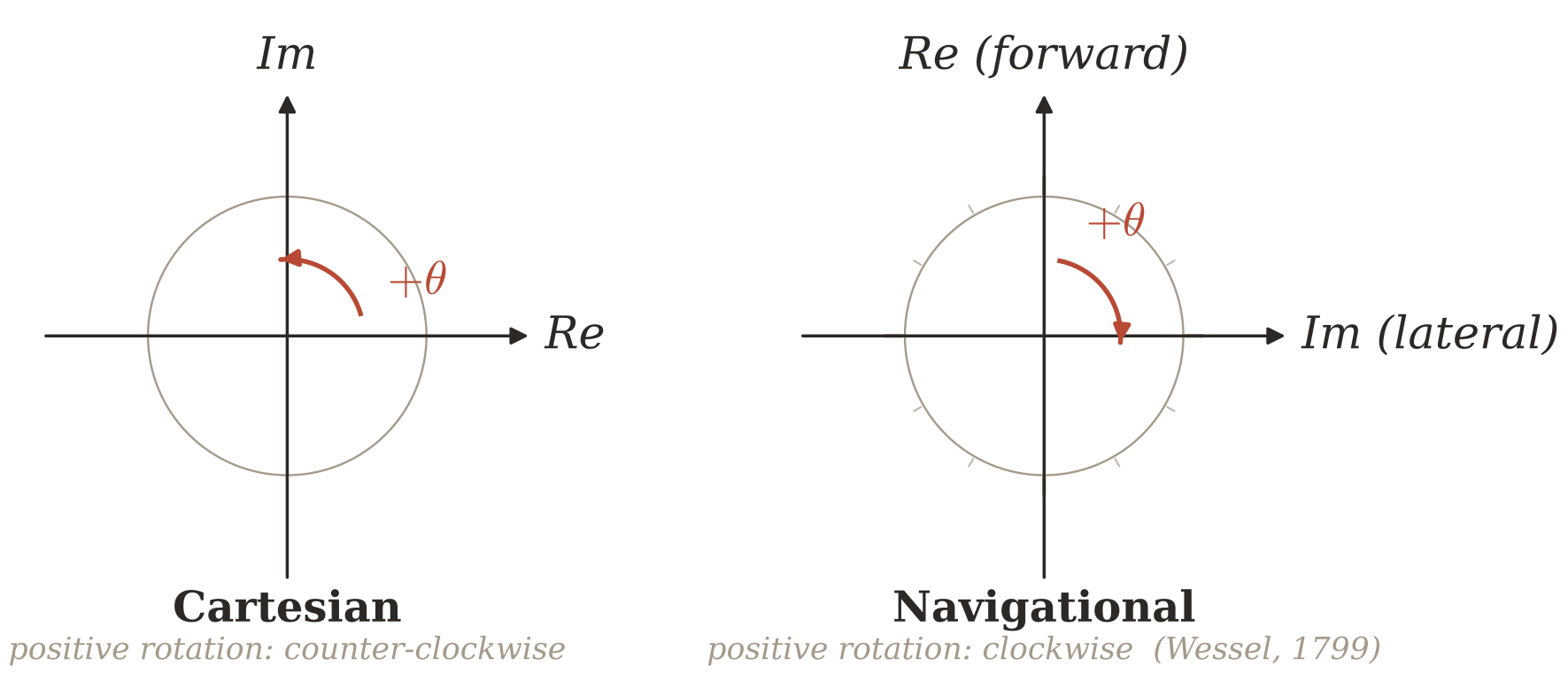
Flip the axes Wessel's way — and starts rotating clockwise, like a compass, a ship's wheel, and a vessel's heading.
Full paragraph (abstract translation)
The complex plane was first given geometric form by Caspar Wessel (1799), and his background explains a lot: Wessel was a Norwegian surveyor, and his motivation was an analytic representation of direction. In a surveyor's world the natural orientation is navigational: forward is up, "to the side" is right, and positive rotation follows the hands of the clock.
Argand's diagram, however — the one that made it into the textbooks — chose a Cartesian orientation: the real axis horizontal, positive rotation going counter-clockwise.
Restore Wessel's system: point the real axis upward and the imaginary axis to the right. Positive rotation from to , algebraically the same, becomes clockwise rotation. The complex exponential now turns together with the clock hand, with the compass going from north to east, and with a ship's heading bearing to starboard. Gauss's direct and lateral are recovered as forward and sideways.
The angular debt inherited from Cartesian diagrams — not from the geometry itself — simply evaporates.
Why it matters
- In navigation, robotics, and motor control, "angle" is almost always clockwise from north. Mathematical physics, by habit, insists on translating everything into "counter-clockwise from east." Every such translation is a source of sign errors.
- Wessel's convention makes the very same motion as a compass's , with no corrections.
- The algebra of does not change: only the picture on the blackboard does.
Reference
- Wessel, C. (1799) Om directionens analytiske betegning. Nye samling af det Kongelige Danske Videnskabernes Selskabs Skrifter, 5, 469–518. sophiararebooks.com