The Gosper island as a fundamental domain
The unit interval is a fractal
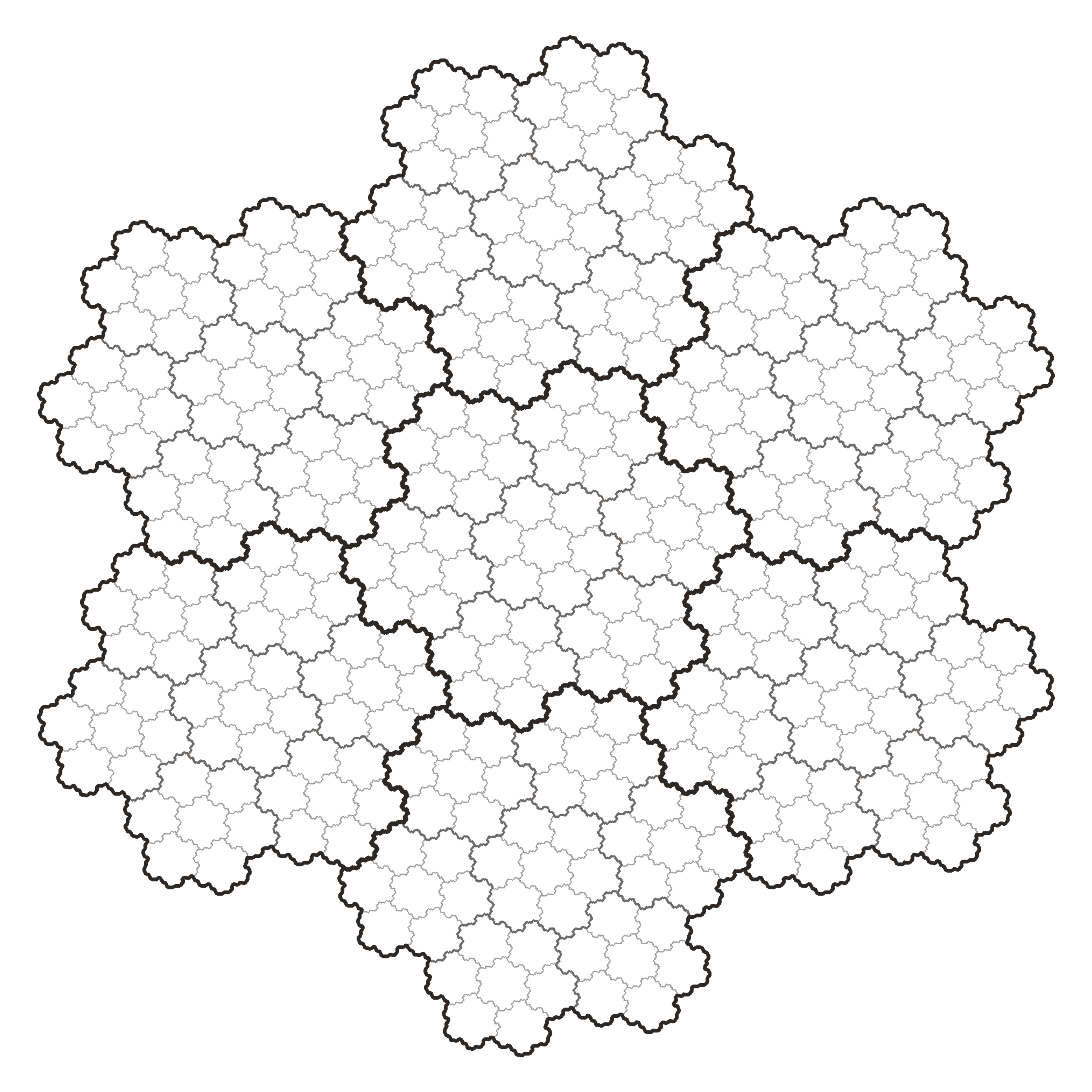
The attractor of the base- numeral system is the Gosper island.
Full paragraph (abstract translation)
What does the "unit interval" look like in this numeral system?
In decimal, all infinite digit strings fill up . The analogous attractor in base is something completely different: a fractal made of seven self-similar copies with contraction ratio .
It was discovered by Bill Gosper in 1973; it was first publicly described by Martin Gardner in the Mathematical Games column of Scientific American (December 1976), and later Benoît Mandelbrot (1977) named it the Gosper island.
It tiles the plane by translations — no gaps, no overlaps — and its boundary is nowhere smooth. This is the natural fundamental domain of complex arithmetic on the hexagonal lattice: the very shape the unit interval always wanted to be.
Why this is not just a pretty picture
- The boundary of the Gosper island is the very Gosper curve after which one of the canonical space-filling traversals of the plane is named. In GQ128 this traversal is used as a serialization of values — locality on the curve corresponds to proximity in the complex plane.
- The Hausdorff dimension of the boundary is . So the boundary is a curve, but "thicker" than usual; this is the geometric source of the isotropic quantization error that the square lattice does not have.
References
- Gardner, M. (1976) Mathematical games: In which "monster" curves force redefinition of the word "curve". Scientific American, 235(6), 124–129. scientificamerican.com
- Mandelbrot, B. B. (1977) Fractals: Form, Chance, and Dimension. San Francisco: W. H. Freeman. archive.org